






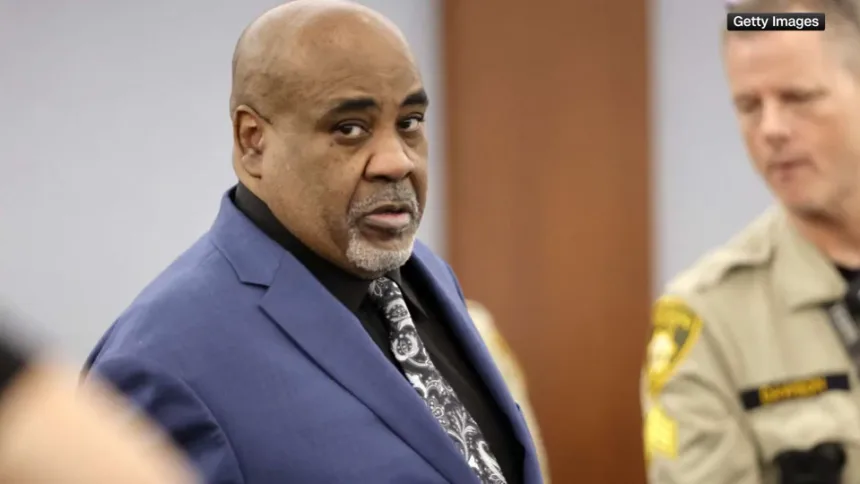
Nearly 30 years after the death of legendary rapper Tupac Shakur, a Las Vegas jury has found former gang leader Duane “Keffe D” Davis guilty of his murder. The verdict marks the first conviction in one of the most closely followed unsolved cases in the history of hip-hop.
Davis, 63, was convicted of murder involving the use of a deadly weapon in connection with the drive-by shooting that killed Shakur in Las Vegas on 7 September 1996. The rapper was only 25 years old at the time and was at the height of his career. He was shot while travelling in a car with Death Row Records founder Marion “Suge” Knight. Shakur suffered multiple gunshot wounds and died in hospital six days later.
According to prosecutors, Davis played a leading role in planning the attack. They argued that the shooting was carried out as an act of revenge following a fight earlier that evening involving Davis’s nephew, Orlando Anderson, and Shakur’s group. Davis was a senior figure in the South Side Compton Crips street gang and was alleged to have organised the men involved in the attack.
Although Davis was not accused of actually pulling the trigger, prosecutors maintained that he helped arrange the shooting and provided the weapon used in the attack. They argued that his position as a gang leader meant that he had the authority to direct the younger men travelling with him.
A major part of the prosecution’s case came from Davis’s own statements. In a police interview in 2008, he acknowledged that he had been inside the vehicle from which the shots were fired. He later described his involvement in greater detail in his 2019 memoir, Compton Street Legend, as well as in interviews and media appearances.
Prosecutors argued that Davis had repeatedly placed himself at the centre of the events surrounding Shakur’s death. They told the jury that his statements, rather than being simply stories or exaggerations, demonstrated that he had knowledge of and responsibility for the attack.
The defence presented a very different argument. Davis’s lawyer claimed that his client’s statements could not be trusted and were exaggerated stories intended to attract attention and generate money from his memoir and media appearances. The defence also pointed out that there was no physical evidence directly linking Davis to the shooting and argued that prosecutors had failed to prove that he had ordered the killing.
Despite these arguments, the jury reached its decision in less than three hours after receiving the case. Davis remained largely expressionless as the guilty verdict was announced in court. He later indicated that he intended to appeal the conviction.
The verdict was an emotional moment for members of Shakur’s family. His sister, Sekyiwa “Set” Shakur, was seen crying and embracing members of the prosecution team after the decision. Other relatives and people in the courtroom were also visibly emotional. Outside the court, fans of the rapper reacted with a mixture of tears, cheers and relief.
Tupac Shakur’s death had remained a mystery for decades and generated numerous theories about who was responsible. His murder also occurred during a particularly tense period in American hip-hop, when rivalries between artists and record labels were closely connected with conflicts involving street gangs.
Shakur became one of the most influential figures in rap, known not only for his music but also for his acting, activism and outspoken views on social issues. He continued to gain new generations of fans after his death, with his music and legacy remaining influential around the world.
Davis was arrested in 2023, almost three decades after the shooting. His trial finally brought the long-running investigation into a courtroom, where jurors had to consider evidence gathered over many years.
The conviction does not bring back the artist whose career was cut short at just 25, but it represents a significant development in a case that had remained unresolved for almost three decades. Davis is scheduled to be sentenced in October and could face life in prison. He has already stated that he intends to challenge the conviction through an appeal.
For Tupac’s family, supporters and millions of fans, the verdict represents a major turning point in a case that has remained one of music history’s most enduring mysteries.


More Stories